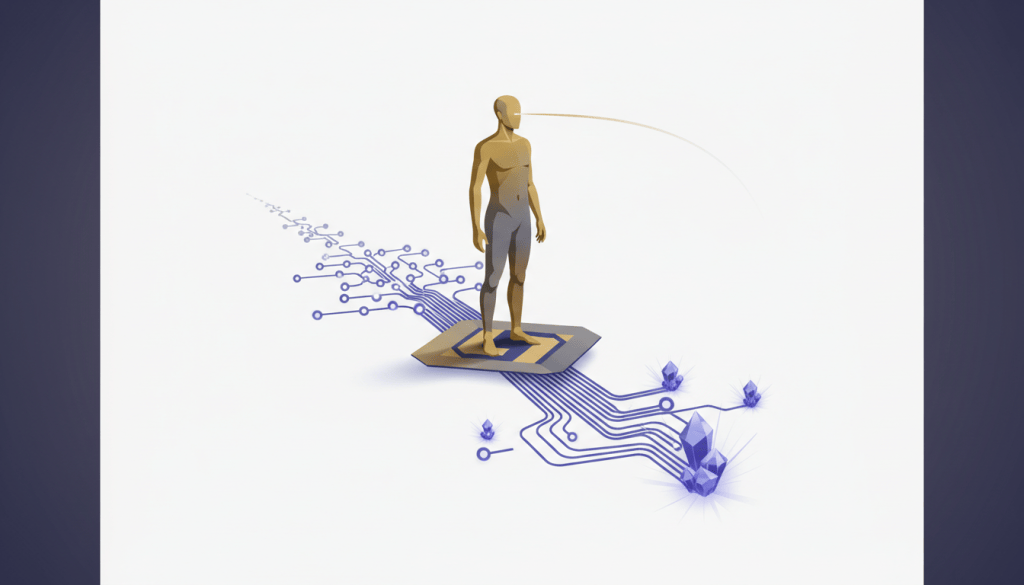
Key takeaway: As AI becomes more capable, the human role does not simply disappear. It appears to move upward—from giving detailed instructions to setting goals, defining boundaries, deciding what to delegate, and determining when human judgment is still necessary.
This is the first English edition of the Human Directing Research Notes, an ongoing public inquiry into one question: What abilities become more important for humans as AI capabilities advance?
In this research, Human Directing is not treated as a finished theory. It is a working concept for examining how human judgment, delegation, oversight, and responsibility change as AI systems become more autonomous.
Human Directing research position 1/4
Current: the shift in the human role → Next: delegation → validation criteria → exception judgment and intervention
Core question: As AI becomes more capable, where does the human role move?
At first, the important skill seemed to be giving better instructions
When generative AI first became widely useful, it was natural to think that the main human advantage would be the ability to write better prompts. A clearer instruction often produced a better result, so the human contribution seemed to sit at the front of the process: define the task, explain the context, and correct the output.
My early idea of Human Directing looked similar. A person would set a direction, tell the AI what to do, inspect the result, and revise the instruction.
But AI started doing more of the intermediate work itself
That picture becomes less complete as AI systems gain the ability to plan, use tools, carry out multiple steps, and return more finished outputs. In many cases, the user no longer has to specify every intermediate action.
This creates a different kind of human responsibility. Instead of deciding every step, the person increasingly decides what the goal is, what the AI is allowed to do, what should remain outside its authority, and what counts as an acceptable result.
Does a stronger AI make the human role less important?
Not necessarily. The role may be changing rather than disappearing. Detailed intervention can decrease while higher-level decisions become more consequential.
For example, if a person has to approve ten separate actions, each decision affects one step. But if the person defines a policy that lets an AI agent perform hundreds of actions autonomously, one human decision can shape the entire workflow.
This is one reason the question “What should humans still do?” may be too narrow. A better question may be: At what level should human judgment remain?
What this looked like in actual AI use
In practical projects, I noticed that I was spending less time on repetitive execution and more time deciding whether a process should be automated, what should require approval, which outcomes mattered, and whether the workflow itself needed to be changed.
That does not prove a universal rule. It is simply an observation from repeated use: as AI handles more of the execution, the human contribution appears to move toward direction, boundaries, acceptance criteria, and responsibility.
Fact, current hypothesis, and interpretation
- Fact: AI systems are increasingly able to perform multi-step work and use tools with less step-by-step instruction.
- Current hypothesis: As AI capabilities increase, human involvement may shift from detailed execution toward higher-level goal setting, delegation, boundaries, approval, and responsibility.
- Interpretation: Human Directing may be better understood as a changing layer of human judgment around AI systems, rather than as a prompt-writing skill.
Frequently asked questions
Will AI reduce the need for human involvement?
Some forms of involvement will likely decrease. Repetitive instructions, routine checking, and manual coordination may shrink. But higher-level decisions about goals, boundaries, risk, and responsibility can remain important—and may affect more actions than before.
Is Human Directing just prompt engineering?
No. Prompt engineering focuses on how to communicate a request effectively. Human Directing is a broader working concept that also includes delegation, authority, intervention, validation, and responsibility.
Is Human Directing a proven theory?
No. It is a research hypothesis. The purpose of this series is to test it against real AI use, existing research, counterexamples, and changes in AI capability.
Next research question
If AI can increasingly perform the work on its own, what exactly should humans still decide—and how much should they delegate?
Original Korean edition
Read the original Korean article →
This is an open research note, not a declaration of a finished theory. If your experience with AI suggests a different pattern or provides a counterexample, that is valuable evidence too.
Continue the Human Directing Research Notes
This article is part of an ongoing public research series tracking how human judgment and responsibility shift as AI capabilities advance.
- Part 1 — As AI Gets Smarter, Where Does the Human Role Move?
- Part 2 — When AI Agents Work on Their Own, What Should Humans Still Decide?
- Part 3 — If AI Produces the Result, Where Does Human Judgment Remain?
- Part 4 — If AI Handles Most of the Work, When Should Humans Step In?
View all Human Directing Research Notes →
This is an open research series rather than a finished theory. If your experience with AI suggests a different pattern or a useful counterexample, please share it in the comments.


답글 남기기