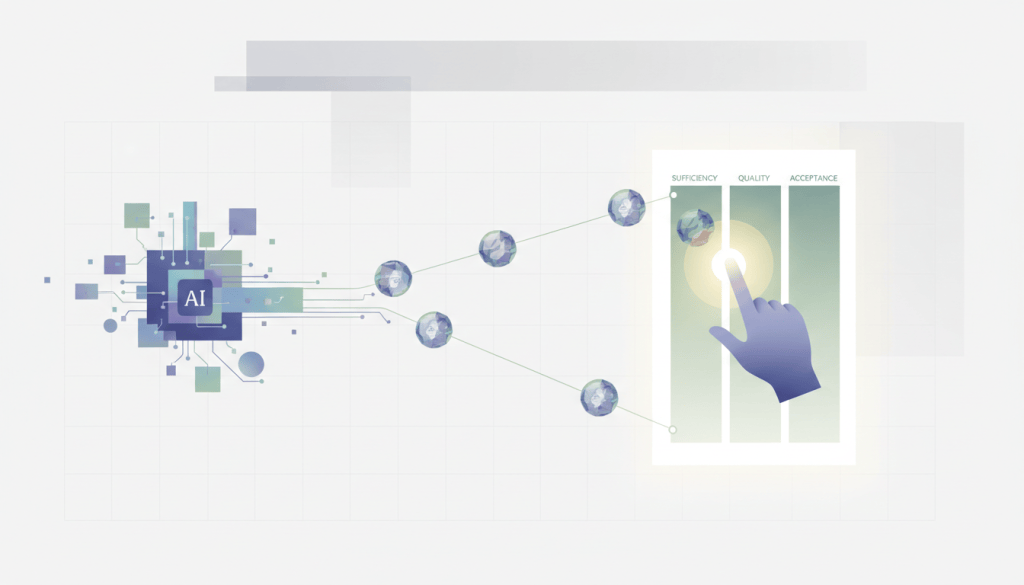
Key takeaway: As AI produces more complete outputs, the human role may move from directing how the work should be done toward deciding when the result is sufficient, usable, and safe to accept.
This is the third English edition of the Human Directing Research Notes. The research has moved from instruction to delegation. The next question is about acceptance: If AI can plan, execute, and produce the result, where does human judgment remain?
Human Directing research position 3/4
the shift in the human role → delegation → Current: validation criteria → exception judgment and intervention
A correct result is not always a usable result
An AI-generated output can look complete and still be insufficient. A document may be well written but miss a critical condition. A system may be implemented but not yet proven in real use. A plan may be logically coherent but impractical in the environment where it must operate.
This makes validation more than error checking. The question becomes: Does this result actually solve the problem? Is anything important missing? Can we move to the next step?
Actual observation
In practical system work, I repeatedly had to distinguish between different kinds of “done”: implementation complete, end-to-end flow complete, and real-world validation complete. AI could help produce the result, but the acceptance threshold still had to be defined.
Fact, current hypothesis, and interpretation
- Fact: AI can increasingly produce finished-looking outputs across research, writing, planning, and software work.
- Current hypothesis: As AI handles more of the production process, an important human role may shift toward defining what counts as a sufficient result.
- Interpretation: Verification is not only about whether the AI is wrong. It is about whether the outcome should be accepted, revised, escalated, or stopped.
Frequently asked questions
Will better AI reduce the need for human verification?
Routine error checking may decrease. But decisions about whether an outcome is sufficient for a specific goal may remain important, especially in high-impact work.
Is Human Directing verification just quality control?
It is broader. It includes deciding whether to accept the result, send it back for revision, escalate it to a human, or end the task.
Next research question
If humans do not need to verify everything, when exactly should they step back in?
Original Korean edition
Read the original Korean article →
Continue the Human Directing Research Notes
This article is part of an ongoing public research series tracking how human judgment and responsibility shift as AI capabilities advance.
- Part 1 — As AI Gets Smarter, Where Does the Human Role Move?
- Part 2 — When AI Agents Work on Their Own, What Should Humans Still Decide?
- Part 3 — If AI Produces the Result, Where Does Human Judgment Remain?
- Part 4 — If AI Handles Most of the Work, When Should Humans Step In?
View all Human Directing Research Notes →
This is an open research series rather than a finished theory. If your experience with AI suggests a different pattern or a useful counterexample, please share it in the comments.


답글 남기기