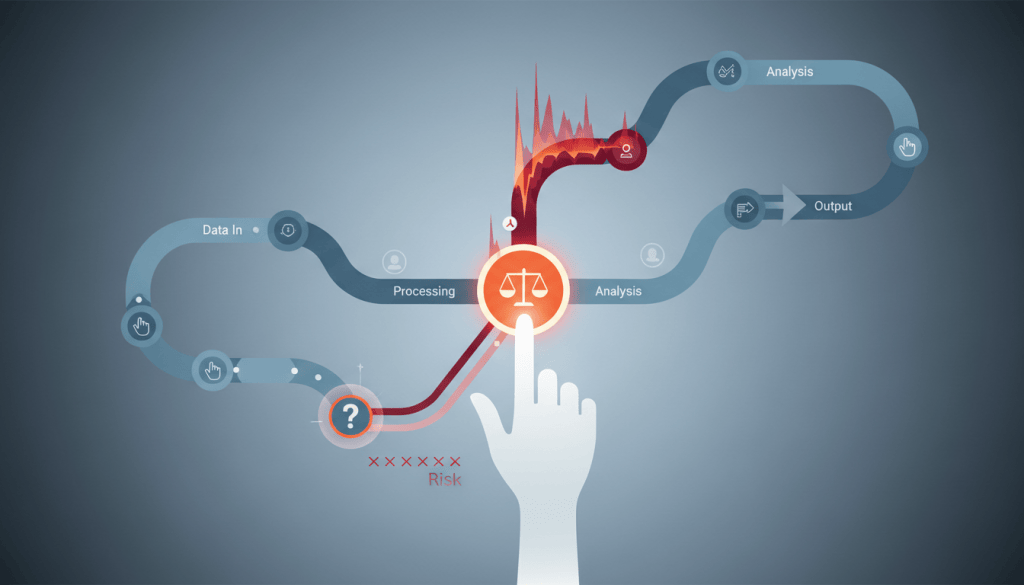
Key takeaway: As AI handles more routine work, humans may not need to inspect every step. The more important capability may be deciding which exceptions matter enough to require human intervention.
This is the fourth English edition of the Human Directing Research Notes. The research has moved through instruction, delegation, and validation. The next issue is selective intervention: When should an automated flow stop and return judgment to a human?
Human Directing research position 4/4
the shift in the human role → delegation → validation criteria → Current: exception judgment and intervention
More approvals do not automatically mean better oversight
If every AI action requires human confirmation, the process may look safer but become slower and more superficial. Repeated approvals can become routine, and routine approval can reduce attention exactly when an important exception appears.
This suggests that the design problem is not simply “more human oversight” versus “more automation.” It is about choosing the moments where human involvement has the highest value.
Actual observation
In workflow design, adding approval at every stage did not necessarily improve quality. What mattered more was deciding which conditions should stop the automated flow: public release, financial impact, irreversible changes, unfamiliar exceptions, or conflicting goals.
Fact, current hypothesis, and interpretation
- Fact: AI workflows can be designed with different levels of autonomy, approval, and escalation.
- Current hypothesis: As AI handles more normal cases, human attention may become most valuable at high-impact or unusual exceptions.
- Interpretation: Human judgment may shift from asking “Is this wrong?” to asking “Is this difference important enough to stop the system?”
When should humans step in?
- Irreversible actions: deletion, publishing, payment, contracts, or major changes
- High-impact outcomes: effects on customers, finances, reputation, or safety
- New exceptions: situations that existing rules do not cover well
- High uncertainty: cases where the AI cannot reliably choose among plausible options
- Conflicting objectives: tradeoffs among speed, cost, quality, safety, or fairness
Frequently asked questions
Is reviewing every AI result the safest approach?
Not always. Excessive review can create approval fatigue. Concentrating human attention on consequential exceptions may be more effective.
What kinds of tasks are easiest to automate fully?
Low-impact, reversible, repetitive tasks are usually the easiest candidates. High-impact or hard-to-reverse actions need stronger escalation criteria.
Next research question
If AI can detect exceptions and risk well enough to call a human only when needed, what kind of human judgment remains?
Original Korean edition
Read the original Korean article →
Continue the Human Directing Research Notes
This article is part of an ongoing public research series tracking how human judgment and responsibility shift as AI capabilities advance.
- Part 1 — As AI Gets Smarter, Where Does the Human Role Move?
- Part 2 — When AI Agents Work on Their Own, What Should Humans Still Decide?
- Part 3 — If AI Produces the Result, Where Does Human Judgment Remain?
- Part 4 — If AI Handles Most of the Work, When Should Humans Step In?
View all Human Directing Research Notes →
This is an open research series rather than a finished theory. If your experience with AI suggests a different pattern or a useful counterexample, please share it in the comments.


답글 남기기